A lot of EV owners hear about bidirectional charging and assume it simply means a faster or smarter way to charge their car. But that is not really what it does.
A bidirectional EV charger changes the direction electricity can flow. Instead of only sending power into your car, it can also send stored energy back out again.
That means your EV can do more than just drive. In some setups, it can help power your home, store excess solar energy, or even send electricity back to the grid.
Here's how it actually works.
1. Normal EV charging only works one way
In a standard home charging setup, electricity flows one way:
Grid → charger → EV battery
This is called unidirectional charging.
The charger takes electricity from your home's supply and stores it in the car battery. Once it is there, the energy stays there until you use it for driving.
That is how most EV charging works today.
Simple, but limited. Once the battery is full, it cannot do much else.
2. Bidirectional charging changes the flow
Bidirectional charging allows electricity to move both ways. Instead of only charging the battery, the system can also discharge it when needed.
That changes the energy flow to:
Grid ↔ EV battery
or
Home ↔ EV battery
To make this possible, the charger and vehicle both need to support two-way energy transfer.
This matters because EV batteries are large. In many cases, they hold much more stored energy than a standard home battery.
Instead of sitting unused in the driveway, that energy can become part of your home's wider power system.
3. Vehicle-to-home (V2H) lets your car power the house
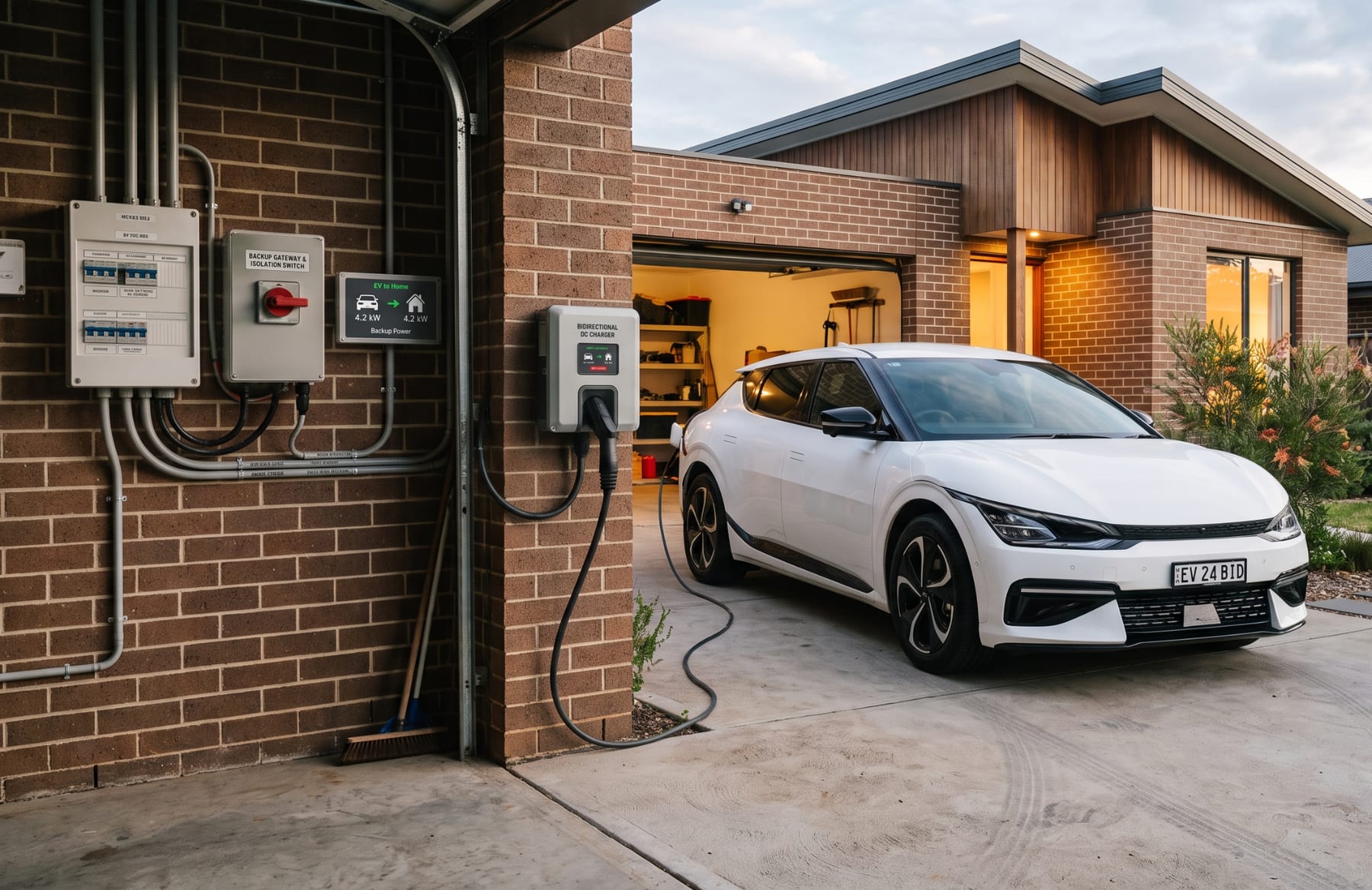
One of the most practical uses of bidirectional charging is vehicle-to-home, often shortened to V2H.
This means your EV can send power back into your house when needed.
For example:
- Running appliances during peak electricity pricing
- Using stored energy after sunset
- Reducing how much power you pull from the grid
Think of it like a battery system, except the battery is your car. This can be especially useful if you already have rooftop solar.
Instead of exporting excess solar during the day, you may be able to store that energy in your EV and use it later.
4. Vehicle-to-grid (V2G) sends energy back to the network
V2G works a little differently. Instead of powering your home, energy flows back into the electricity grid.
This allows your EV battery to act like a temporary energy source for the wider network.
In theory, this can help:
- support the grid during peak demand
- absorb excess renewable energy
- reduce pressure during heavy usage periods
In some electricity markets, homeowners may also be paid for exporting energy.
But in Australia, this is still developing and depends on network approval, retailer support, and compatible hardware.
5. Solar makes bidirectional charging more useful
This is where the system becomes more interesting. Without solar, bidirectional charging mostly shifts grid electricity around.
But with solar, the energy flow can look like this:
Solar → EV battery → home → grid
This gives you more flexibility over when you use your solar energy.
For example:
During the day:
- solar charges your car
At night:
- your car helps run the house
If there is still excess:
- some systems may export back to the grid
This can increase self-consumption, which usually matters more than simply generating power.
Because the more solar energy you use yourself, the less electricity you need to buy later.
6. Not every EV can do it
This is where many people get caught out. Owning an EV does not automatically mean you can use bidirectional charging.
There are usually four requirements:
- Compatible vehicle. The car itself must support two-way charging.
- Compatible charger. Not all chargers can discharge power back out.
- Network approval. In Australia, some setups may need approval from your electricity distributor.
- Correct system design. The charger, switchboard, and home load setup all need to work together properly.
Without all four, the system may not function the way people expect.
7. It is still early in Australia
Bidirectional charging is growing, but it is still early.
More EV manufacturers are adding support, and more chargers are entering the Australian market.
But there are still limits:
- not all brands allow V2G or V2H
- some battery warranties may restrict it
- installation standards are still developing
- retailer programs are still limited
That means for many homeowners, it is less about installing it today and more about planning for it properly.
Especially if you are already looking at solar, batteries, or EV charging as part of the same system.
Conclusion
So, what is bidirectional charging?
It is a charging system that allows electricity to move both into and out of your EV battery. That changes the role of your car completely.
Instead of being just transport, it can become part of your home's energy system; storing solar, powering your house, or supporting the grid when needed.
But like most energy systems, the real performance depends on how everything is designed to work together.
If you want to understand how bidirectional charging could fit into your solar setup, EV usage, or future battery planning, the engineering team at Guwing Green can help map out what makes sense for your home before you make any decisions.
Filed under