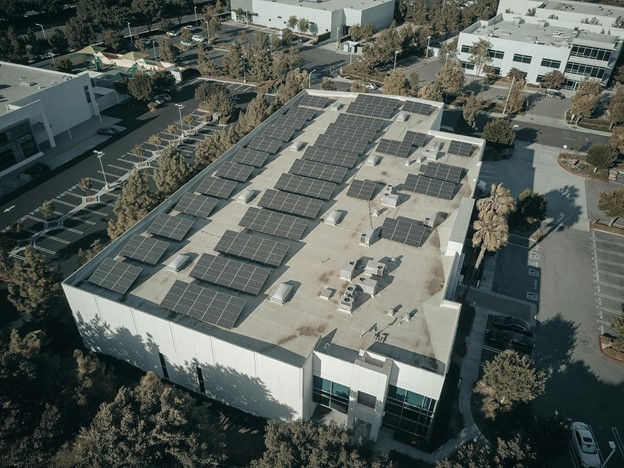
Electricity use is rarely simple for a business, and commercial battery storage is one of the tools helping Sydney operators get more control over it.
In simple terms, a battery stores energy so it can be used later instead of straight away. Paired with solar generation, it helps a business make better use of infrastructure it already owns, rather than exporting cheap daytime solar and buying it back at a higher price that evening.
The more useful question is whether storage makes sense for the way your business actually uses energy. That is a job for an engineering assessment rather than a generic pitch. At Guwing Green, the assessment starts with your own meter data, not a size chart. Our SAA-accredited engineers model how the business actually uses electricity first, then recommend whether a battery makes sense and, if so, what size fits.
How Commercial Battery Storage Works
The idea is straightforward: store energy when it is available and use it later, when it is actually needed.
That gives businesses with shifting demand more flexibility. A retailer or office might generate plenty of solar during the day but still face significant demand in the late afternoon and evening, well after the sun has done most of its work.
A typical setup runs like this. Solar panels generate during the day, the business uses what it needs in real time, and any surplus is directed into the battery instead of being exported. Once the sun goes down or usage picks up, that stored energy is drawn back out and used on site.
Solar generation feeds business consumption, surplus fills battery storage, and stored energy covers the evening load. Every step that keeps a kilowatt-hour on site is worth more than exporting it.
Factors to Weigh Before Installing Commercial Storage
There is no one-size-fits-all battery setup for a commercial property, so it pays to work through the following:
- Current energy consumption. Understand how much electricity the business uses and, more importantly, when.
- Existing solar. Look at how much the system generates and how much of it is consumed on site rather than exported.
- Operating hours. A business running mainly during daylight has very different storage needs from one trading into the evening.
- Available space. Batteries and their associated equipment need somewhere to go, with the right clearances, so factor in the physical footprint before locking in a size.
- Future energy needs. Planning to add machinery, EV chargers or floor space? Factoring that in now is cheaper than resizing a system later.
- Budget. Weigh the upfront investment against long-term savings, and account for the incentives that can bring the cost down.
- System compatibility. Existing solar, electrical infrastructure and other equipment all narrow the available options.
Every business energy profile looks different. A warehouse may have large daytime loads and substantial roof space. A retail business uses electricity steadily through opening hours. A commercial office concentrates most of its demand inside the working day.
Evaluating Costs, ROI and Next Steps
The battery itself is only part of the cost. A full project also accounts for the site's physical characteristics, electrical work, supporting equipment, installation, monitoring and integration with existing systems. That is why a generic per-battery price tag is not much use when working out whether storage stacks up.
Look instead at the total project cost alongside the value it delivers over time. Be specific about what you want the battery to achieve:
- Reduce reliance on grid electricity at particular times of day.
- Make better use of existing solar generation.
- Manage periods of high demand.
- Provide backup for selected equipment.
- Prepare for additional electrical loads.
- Improve overall energy management and visibility.
Our guide to commercial solar payback walks through how those benefits translate into a return figure you can actually take to a board.
Government Incentives That Can Offset the Cost
The cost side of this equation is shifting quickly. Since 1 September 2026, the NSW Government has extended its Peak Demand Reduction Scheme to commercial-scale batteries for the first time, through two new activities: BESS4 for small and medium businesses installing systems of roughly 20 to 200kWh, and BESS5 for larger commercial and industrial systems.
Eligible projects earn Peak Reduction Certificates, administered by IPART, that go towards the upfront cost.
Smaller systems have another avenue. The federal Cheaper Home Batteries Program, despite the name, is also open to small businesses, offering a discount of around 30% on the upfront cost of eligible battery systems up to 100kWh.
On top of either of those, eligible small businesses with aggregated turnover under $10 million can generally claim the $20,000 instant asset write-off on qualifying equipment costing less than $20,000 per asset, now a permanent feature of the tax system rather than an annual extension. Systems above that threshold can still be depreciated through the small business pool.
| Support | Who it suits | What it does |
|---|---|---|
| NSW PDRS BESS4 | Small and medium businesses, roughly 20 to 200kWh | Peak Reduction Certificates towards upfront cost |
| NSW PDRS BESS5 | Larger commercial and industrial systems | Peak Reduction Certificates towards upfront cost |
| Cheaper Home Batteries Program | Small businesses, systems up to 100kWh | Around 30% off the upfront cost of eligible systems |
| Instant asset write-off | Turnover under $10 million, assets under $20,000 | 100% deduction in the year the asset is installed ready for use |
Eligibility depends on battery size, site type and installation date, so it is worth checking the details before locking in a budget. As SAA-accredited engineers, we can work through which of these a project may qualify for as part of the design and quoting process, alongside advice from your accountant.
Frequently Asked Questions
What is commercial battery storage?
A system that stores electricity so a business can use it later instead of straight away. It is commonly paired with solar and other on-site energy systems.
Can a business use a battery with existing solar panels?
In most cases, yes. Storage can usually be added to an existing solar system, but compatibility and your electrical setup have to be assessed first. Because we work across multiple battery brands rather than one, that assessment is about what suits your existing system, not what we happen to stock. Our guide to AC coupled batteries explains the retrofit path.
Is a commercial battery suitable for a small business?
It can be. Suitability comes down to consumption, operating patterns, existing solar and what you want the battery to achieve, which is exactly what an energy audit is designed to work out.
Can a commercial battery provide backup power?
Some systems can provide backup during an outage, but it depends on how the system is designed and which circuits are configured to receive that backup. It has to be specified up front rather than assumed.
How do I know what size battery my business needs?
Start with actual consumption and operating patterns rather than guessing from a brochure. Twelve months of interval meter data turned into a clear picture of when the business draws power is what determines the right size.
Are there government incentives for commercial battery storage in NSW?
Yes, and the options have just expanded. Since 1 September 2026 the NSW Peak Demand Reduction Scheme includes commercial batteries through BESS4 for small and medium businesses and BESS5 for larger commercial and industrial systems. Smaller systems up to 100kWh may also access the federal Cheaper Home Batteries Program, and eligible small businesses can generally claim the $20,000 instant asset write-off.
Does Commercial Battery Storage Stack Up for Your Business?
Commercial storage can be a genuinely useful part of an energy strategy, particularly for businesses looking to better manage solar generation, consumption or periods of high demand.
But the decision comes down to your current energy use, existing solar, operating patterns, future requirements and, increasingly, the incentives on offer. From there you can work out whether storage addresses a real need and whether the expected benefits justify the investment.
If you would rather talk it through with an engineer than a salesperson, get in touch. Our SAA-accredited engineers walk you through solar, storage and energy management options based on your actual energy data, and our work with businesses starts the same way every time.
Filed under