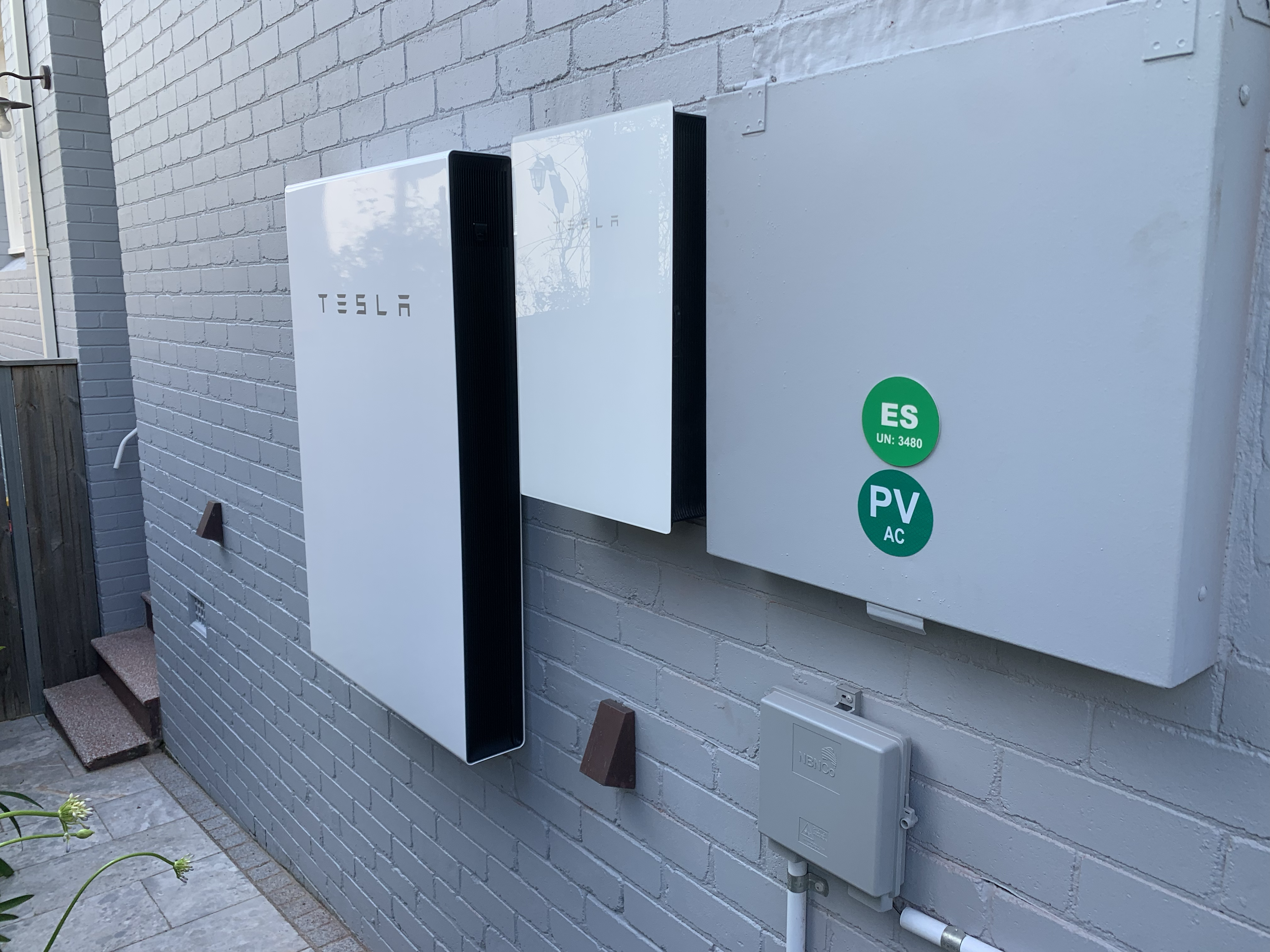
An AC coupled battery is a home battery with its own inverter, installed on the household side of your existing solar inverter rather than wired into the panels themselves.
It is the standard way Sydney homeowners add storage to solar they already own, without touching the original system.
Feed-in tariffs keep falling. For 2026-27 the IPART benchmark for NSW solar exports sits at just 3.4 to 6.5 cents a kilowatt-hour, down again on the year before. That is why so many owners are now asking whether a home battery is actually worth it in 2026 instead of sending surplus solar to the grid for small change.
What Is an AC Coupled Battery?
To understand an AC coupled battery, it helps to think of your home's power as two different languages:
- DC (direct current). The raw electricity generated by solar panels and stored inside batteries.
- AC (alternating current). The standard household electricity that powers your fridge, TV and wall sockets.
Your rooftop solar panels need a converter box called an inverter to convert raw solar power (DC) into household power (AC).
An AC coupled battery has its own built-in inverter. Instead of wiring directly into your roof panels, it plugs right into your home's main electrical switchboard. It simply watches your electricity meter, catches any leftover solar power before it gets sent out to the street, and saves it for later.
How AC Coupling Works, Step by Step
Here is a simple look at how energy moves through your home during the day and night with an AC coupled battery system.
- Daytime solar generation. Sunlight hits your roof panels, producing raw DC electricity. This power travels down cables to the solar inverter on your wall.
- Solar power conversion. Your existing solar inverter converts that raw energy into standard AC electricity, which feeds directly into your lights and appliances.
- Catching surplus energy. If your panels make more electricity than your home is using, the extra power flows toward the main switchboard. A smart meter spots this surplus and alerts the battery.
- Charging the battery. The battery's internal converter takes that extra household AC power, converts it back into raw DC energy, and stores it in the battery cells.
- Evening discharge. When the sun sets, the battery converts its stored energy back into household AC electricity, keeping your home running on your own solar power long after dark.
The two inverters in an AC coupled system
Because an AC coupled system works as an add-on, your home will end up with two separate converter boxes:
- Your original solar inverter. This box stays mounted on your wall, doing the exact same job it has always done. Leaving it untouched preserves your original installer warranty and avoids expensive rewiring.
- The battery inverter. This dedicated inverter manages charging and discharging the battery. It turns household power into stored energy, and stored energy back into household power when needed.
Most modern batteries, including the Enphase IQ Battery 5P, build that second inverter into the battery cabinet itself, so only one extra unit goes on the wall.
The Tesla Powerwall 3, Sigenergy, Sungrow and Goodwe go further again: they have a solar inverter built in as well, which is why they can run as an all-in-one hybrid on a new install or as an AC coupled retrofit alongside solar you already own.
AC Coupled vs DC Coupled: What's the Real Difference?
When shopping around, you will hear people compare AC coupled batteries with DC coupled batteries. Neither option is better in every situation. The right choice comes down to whether you already have solar panels on your roof.
Efficiency
Every time electricity gets converted from raw DC power to household AC power, or back again, a small amount of energy is lost as heat.
- AC coupled systems run at a round-trip efficiency of around 90% to 94%. Power gets converted three times (panels to house, house to battery, battery to house), and a little is lost at each step.
- DC coupled systems run at around 95% to 98%. Power goes straight from the panels into the battery through a shared converter box, skipping the extra middle step.
DC coupling does hold onto a little more energy. For a home pushing roughly 10 kWh through the battery each day, that four-point gap is worth somewhere around $50 to $70 a year at Sydney retail rates. Real money, but rarely enough to justify ripping out a solar inverter that still works.
Installation cost and convenience
To install a DC coupled battery on an existing solar setup, an electrician has to remove your working solar inverter, fit a new hybrid unit in its place, and rewire the DC side of the array. That adds real labour and equipment cost.
An AC coupled battery simply connects to your existing switchboard. Your roof panels, existing solar inverter and warranties stay untouched.
Which should you choose?
| Your household situation | Best choice | Why it works best |
|---|---|---|
| Existing solar inverter is under 5 years old | AC coupled | Keeps your working inverter and warranty intact, saving on installation costs |
| Existing solar inverter is very old (8+ years) | DC coupled, or AC | If your old solar inverter needs replacing anyway, swapping to a single hybrid inverter can make sense |
| Installing solar and a battery together from scratch | DC coupled | Slightly better efficiency, since you only buy one combined converter box |
| You have Enphase microinverters on your roof | AC coupled | Microinverters send household power down from the roof, so AC coupling is the only option that works |
Which Popular Batteries Are AC Coupled?
Knowing which category popular brands fall into helps when comparing quotes from local Sydney installers.
Common AC coupled batteries
- Tesla Powerwall 2. The unit that made AC coupling mainstream. Its battery inverter is built in and it connects at the switchboard, so it works alongside any brand of existing solar. It has now largely been superseded by the Powerwall 3.
- Tesla Powerwall 3. Strictly speaking an all-in-one unit with a solar inverter built in, so on a brand new system it runs DC coupled. On a retrofit, where your existing solar inverter stays put, it connects as an AC coupled battery instead.
- Enphase IQ Battery 5P. Uses modular microinverter technology. It connects via standard household wiring and works alongside any solar system brand.
Common DC coupled batteries
- Sungrow SBR and SBH series. Stacking battery units designed to work directly with Sungrow's own range of hybrid solar inverters.
- SolarEdge Home Battery. Connects directly to the internal DC wiring of SolarEdge hybrid solar inverters.
Pros and Cons of an AC Coupled Battery
Weighed against a DC coupled retrofit, an AC coupled battery trades a small efficiency gap for flexibility and simplicity.
Advantages
- Protects existing warranties. Your original rooftop solar setup stays completely untouched.
- Works with any solar system. Fits every brand, age or type of existing solar setup.
- Independent equipment. If your solar inverter ever develops a fault, your battery can still run. If the battery has an issue, your solar panels keep working normally.
- Easy to expand later. You can add more battery units in the future without having to redesign your roof wiring.
- Smart grid ready. Built-in software lets you charge from cheap off-peak grid power at night, or join a Virtual Power Plant and get paid for the energy you share back.
Drawbacks
- Slight efficiency loss. Converting electricity three times costs you a few percentage points more than a direct DC connection.
- Two boxes to maintain. You have two separate pieces of hardware on site rather than one all-in-one unit.
- Blackout protection needs extra gear. An AC battery does not automatically power your house during an outage unless you add a backup gateway.
Will an AC Coupled Battery Keep the Power On During a Blackout?
Not on its own. A common myth is that buying any battery means your lights stay on when the neighbourhood goes dark. In reality, standard solar and battery systems shut down automatically during a blackout, a mandatory safety feature called anti-islanding that protects the crews repairing the network.
If you want your AC coupled battery to keep key appliances running during a power outage, your system needs three specific things:
- A backup gateway. A smart isolation switch at your meter box that safely disconnects your home from the main grid within seconds of a power failure.
- A backup-capable inverter. A battery converter that can generate its own stable power signal without relying on the grid.
- An essential load circuit. Wiring that separates critical appliances such as your fridge, lights and internet from heavy power drains like ducted air conditioning.
None of this is automatic, and it has to be specified up front rather than added later. Our guide on battery backup during blackouts covers how to decide which circuits are worth protecting.
Can I Get the Federal Battery Rebate on an AC Coupled Battery?
Yes. The federal rebate applies to any eligible home battery, whether it is AC or DC coupled. Coupling type is not one of the criteria.
Under Australia's national Cheaper Home Batteries Program, homeowners receive an upfront discount created by Small-scale Technology Certificates. The eligibility rules come down to five things:
- Battery size. Between 5 kWh and 100 kWh of nominal capacity. Certificates are only created for the first 50 kWh of usable capacity.
- Approved equipment. The battery model must appear on the Clean Energy Council approved batteries list.
- Accredited installer. The install must be done by an electrician accredited with Solar Accreditation Australia (SAA).
- Solar pairing. The battery has to be connected to a new or existing rooftop solar system. Stand-alone batteries are not eligible.
- VPP capability. The hardware has to be capable of connecting to a Virtual Power Plant. Worth being clear on this one: you do not have to actually join a VPP to claim the federal rebate, the battery just has to be able to.
What changed on 1 May 2026: the STC factor dropped from 8.4 to 6.8 certificates per usable kilowatt-hour, and the discount became tiered. The first 14 kWh of usable capacity earns the full rate, capacity between 14 and 28 kWh earns 60% of it, and anything from 28 to 50 kWh earns just 15%.
At an STC price of around $37, that lands the discount near $250 per usable kilowatt-hour. For a standard 10 kWh or 13.5 kWh battery the tiering changes nothing, because the whole thing sits inside the top band. The rate now steps down every six months rather than once a year.
The NSW top-up most quotes leave off
On top of the federal discount, NSW pays a separate upfront incentive for connecting your battery to a Virtual Power Plant through the Peak Demand Reduction Scheme, and it stacks with the federal rebate. From 1 July 2026 batteries up to 50 kWh qualify, with the payment calculated on the first 28 kWh of usable capacity.
NSW does not publish a fixed dollar figure. Providers commonly advertise up to $1,500, but that ceiling applies to larger systems approaching the 28 kWh cap. Net payments on a typical 10 kWh battery are usually in the $400 to $500 range, so treat the headline number as a maximum rather than a quote.
Ask any installer whether they are claiming it for you, because plenty do not bother with the paperwork, and ask them to show you the per-kWh arithmetic in writing.
Guwing Green is an approved company for these types of schemes, such as the Home Energy Saver program, so feel free to check your eligibility with us.
NSW Network Rules: Adding a Second Inverter in Sydney
One important detail generic guides leave out is how local electricity companies regulate battery inverters in New South Wales.
Because an AC coupled battery adds a second converter box to your home, your installer must follow the rules set by your local network operator. Sydney is split between three:
- Ausgrid. Inner West, Eastern Suburbs, North Shore, Northern Beaches, Central Coast.
- Endeavour Energy. Western Sydney, South West, Blue Mountains, Illawarra.
- Essential Energy. Regional and rural New South Wales.
Ausgrid network area
In Ausgrid areas, your battery converter capacity counts toward your total household limit. Single-phase homes on Ausgrid are generally held to 10 kW of total inverter capacity, with exports capped at 10 kW per phase. So if you already run a 5 kW solar inverter and add a battery with a 5 kW inverter, you land on the limit exactly.
Go past it and your installer has to lodge a technical review, because Ausgrid assesses inverters on their nameplate rating rather than on whatever export limit is programmed in. It will sometimes approve extra battery inverter capacity above the cap, but that is an application, not a given.
Endeavour Energy network area
Endeavour Energy treats storage a little differently. Battery inverters generally do not count against the single-phase inverter limit, which leaves you more room to work with. The trade-off is a tighter export cap: 5 kW per phase on a standard single-phase connection, against Ausgrid's 10 kW.
Endeavour is also rolling out flexible exports, which lets a compatible internet-connected inverter push up to around 10 kW most of the time and dial back when the local network is under strain. It has been running as a trial since 2024 and becomes the default connection offer for new and upgraded solar from late 2026.
In every case, your installer lodges a connection application with the relevant distributor before work begins. This is exactly the kind of site-specific detail our engineers check against your address before quoting, rather than assuming one rule applies across all of Sydney. It is also why system sizing and network limits have to be worked out together.
How Much Does an AC Coupled Battery Cost in Sydney?
The total out-of-pocket cost for an AC coupled retrofit depends on battery size, switchboard condition, and whether you choose blackout backup options.
For a standard Sydney home in 2026, typical turnkey prices after the federal rebate but before the NSW VPP incentive fall into these ranges:
| System size | Installed price after federal rebate |
|---|---|
| 10 kWh AC battery system | $10,800 to $13,500 |
| 13.5 kWh AC battery system | $12,500 to $15,200 |
What can change your final price?
- Switchboard upgrades. Older homes built before 2000 often need safety switches or a modern switchboard to meet current electrical standards.
- Blackout backup setup. Adding emergency isolation switches and essential backup circuits adds roughly $1,000 to $2,200 in parts and labour.
- Installation distance. Long wiring runs between your switchboard, existing solar inverter and new battery increase installation time and conduit costs.
When you are comparing quotes, check that the provider breaks out the full pre-discount price alongside the rebate deduction. Our guide on how to read a solar quote walks through what else to look for.
At Guwing Green, our team checks your actual smart meter data from the past four quarters before recommending a system size, so you get a setup matched to your household's real energy habits rather than a generic sizing rule.
FAQ About AC Coupled Batteries
Can I add an AC coupled battery to my existing solar system?
Yes, this is the primary use case for AC coupling. It works regardless of your existing solar inverter's brand, so long as that inverter is in good working order.
Is an AC coupled battery less efficient than a DC coupled one?
Slightly. AC coupling runs at roughly 90% to 94% round-trip efficiency against 95% to 98% for DC coupling, because of the extra conversion step. On a typical Sydney home that gap is worth $50 to $70 a year.
Can an AC coupled battery charge from the grid?
Yes, in most cases. It needs to be configured correctly against your retailer's time-of-use rates, and should not be set to cycle constantly just to chase a small tariff gap.
Does an AC coupled battery qualify for the Cheaper Home Batteries Program rebate?
Yes. Coupling type is not one of the criteria. What matters is capacity, the approved product list, VPP capability and an SAA-accredited installer.
Which battery brands are AC coupled in Australia?
The Tesla Powerwall 2 and the Enphase IQ Battery range are the classic AC coupled units here. The Powerwall 3 also connects as an AC coupled battery when it is retrofitted to solar you already own, even though it runs DC coupled on a new system.
How long will an AC coupled battery take to pay for itself?
The same six to ten year range that applies to any home battery, since coupling type affects efficiency by a few percentage points rather than changing the economics. See our guide to the solar battery payback period for what actually moves that number.
Conclusion
Deciding on an AC coupled battery comes down to two main things: whether your current solar inverter is still running well, and whether you want to keep your existing warranties intact.
For most Sydney families with working solar panels, AC coupling is the easiest and most practical path to lower power bills.
Not sure whether your existing solar inverter can take an AC coupled battery, or what your network will actually allow you to add?
Our SAA-accredited engineers model your last four quarters of meter data before recommending a system size, so the quote you get reflects your home rather than a generic battery calculator. Talk to our team about solar and battery systems for homeowners for a straight answer, or get in touch directly.
Filed under