The average Australian household spends around $500–$650 per quarter on electricity, with the cost largely determined by the price you pay per kilowatt-hour (kWh). However, electricity rates vary significantly between states, distributors, and even the time of day you use power.
In this guide, we'll explain how electricity pricing works, why rates differ across Australia, and practical ways to reduce your energy costs. If you'd like to start by understanding where your energy goes, an energy audit is often the most revealing first step.
What Does 'Electricity Price per Kilowatt Hour' Actually Mean?
A kilowatt-hour (kWh) is a unit of energy. It's what you consume when you run 1,000 watts (1 kilowatt) of appliances for one hour.
For context, a typical reverse-cycle air conditioner may use 1–2 kWh per hour, depending on its size and operating condition, while 10 × 100-watt light bulbs running for one hour would consume exactly 1 kWh.
Every Australian electricity bill has two main cost components:
- Usage charge: The variable cost per kWh you consume. This is the rate most people refer to when discussing "electricity prices."
- Daily supply charge: A fixed daily fee, typically $0.90–$1.50 depending on your location and plan, for the privilege of being connected to the grid.
For most households, a simplified bill calculation looks like this:
(kWh used × usage rate) + (daily supply charge × number of days) = total before GST
Understanding both components matters. A plan with a low usage rate but a high supply charge can cost more in total, especially for low-consumption households.
Current Electricity Rates by State (2026)
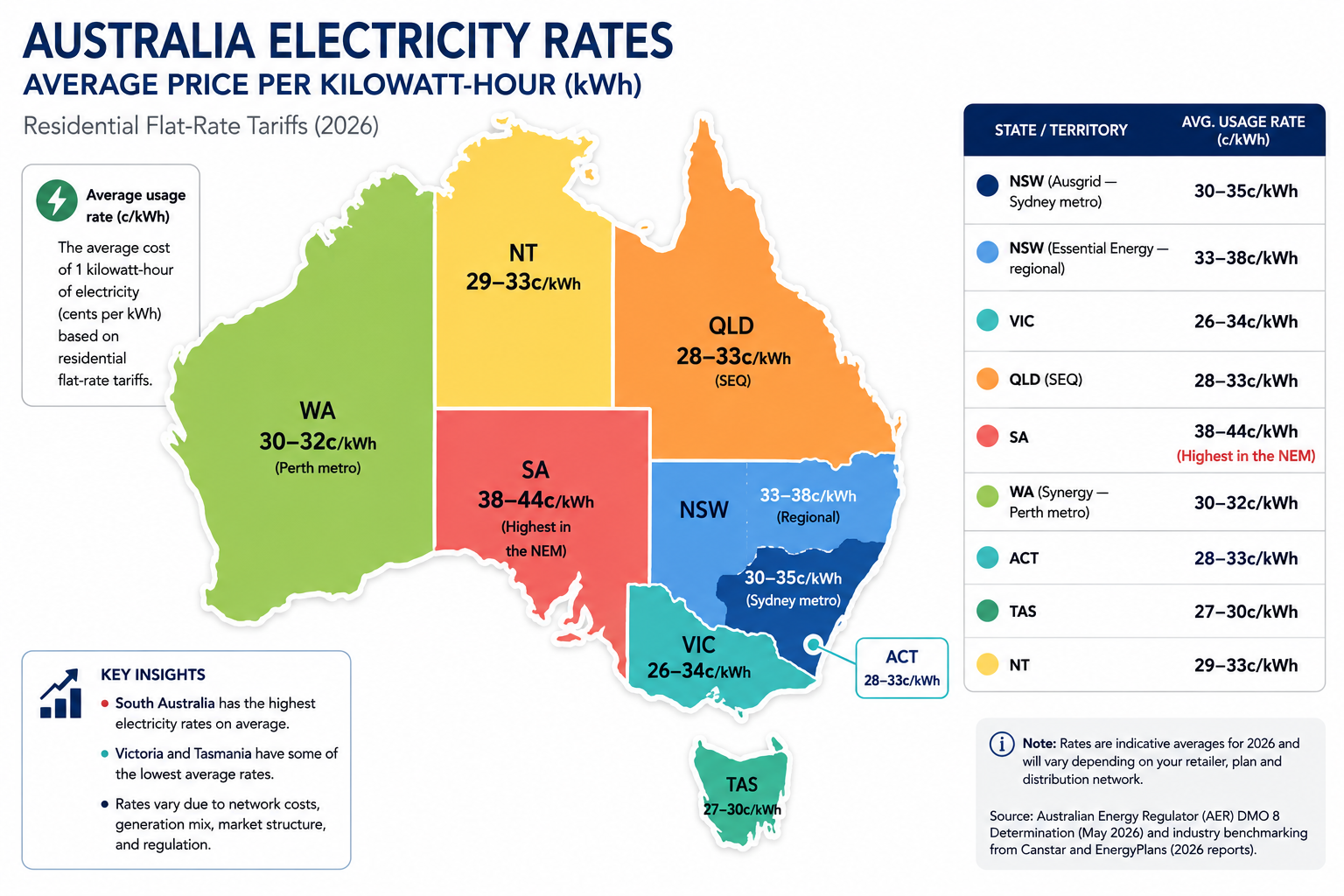
Across Australia, electricity retailers generally charge between 32c and 35c for every kWh of electricity used, depending on your state, distribution network, and tariff type.
The table below shows indicative average usage rates for residential flat-rate tariffs in 2026. Your actual rate will depend on your retailer, plan, and distributor zone.
| State / Territory | Avg. Usage Rate (c/kWh) | Notes |
|---|---|---|
| NSW (Ausgrid — Sydney metro) | ±30–35c / kWh | Regulated by the DMO 8 cap. |
| NSW (Essential Energy — regional) | ±33–38c / kWh | Regional network charges apply. |
| VIC | ±26–34c / kWh | Regulated by the Victorian Default Offer (VDO). |
| QLD (SEQ) | ±28–33c / kWh | Competitive market under DMO 8 caps. |
| SA | ±38–44c / kWh | Consistently the highest in the NEM. |
| WA (Synergy — Perth metro) | ±30–32c / kWh | Government-regulated (Synergy). |
| ACT | ±28–33c / kWh | Among the lowest annual bills nationally |
| TAS | ±27–30c / kWh | Stable, lower average rates. |
| NT | ±29–33c / kWh | Regulated tariff via Power & Water Corp |
Source Attribution: The data is based on the Australian Energy Regulator (AER) DMO 8 Determination (May 2026) and industry benchmarking from Canstar and EnergyPlans (2026 reports). Rates are indicative, always check your own bill or use the government comparison tools.
South Australians pay the highest electricity prices per kWh on average, while households in Victoria and Tasmania generally pay the lowest.
Why Does the Price per kWh Differ So Much Across States?

The National Electricity Market (NEM)
Most of Australia (NSW, VIC, QLD, SA, ACT, and TAS) operates within the National Electricity Market, a competitive wholesale market regulated by the Australian Energy Regulator (AER). Western Australia and the Northern Territory run their own separate electricity systems.
In NEM states, retailers buy wholesale electricity and sell it to households, adding their own margin. Competitive retail markets tend to keep margins lower, while more regulated markets can sustain higher prices. This is a key reason SE Queensland tends to have lower rates than South Australia.
What Actually Makes Up Your Rate?
Your usage rate isn't just the cost of generating electricity. It bundles several components:
- Wholesale energy cost, roughly 30–40% of your bill
- Network charges (poles, wires, maintenance), the single largest component, roughly 40–50%
- Environmental levies: federal and state renewable energy schemes
- Retail margin and metering costs, what your retailer keeps
South Australia's high rates are partly driven by the state's reliance on gas generation and higher network costs. Regional areas in NSW and QLD face higher network charges simply because the infrastructure cost is spread across fewer customers.
Time-of-Use vs Flat-Rate Tariffs
Most households are on one of two tariff structures:
Flat-rate (single rate): One fixed price per kWh regardless of when you use power. Simple and predictable.
Time-of-use (TOU): Different rates depending on the time of day. Peak rates can exceed 45–55c/kWh, while off-peak rates can be as low as 20c/kWh. TOU works well for households that can shift usage — running the dishwasher or washing machine overnight, for example. A smart meter is required to access TOU tariffs; most new connections already have one.
How Solar Reduces Your Effective kWh Cost
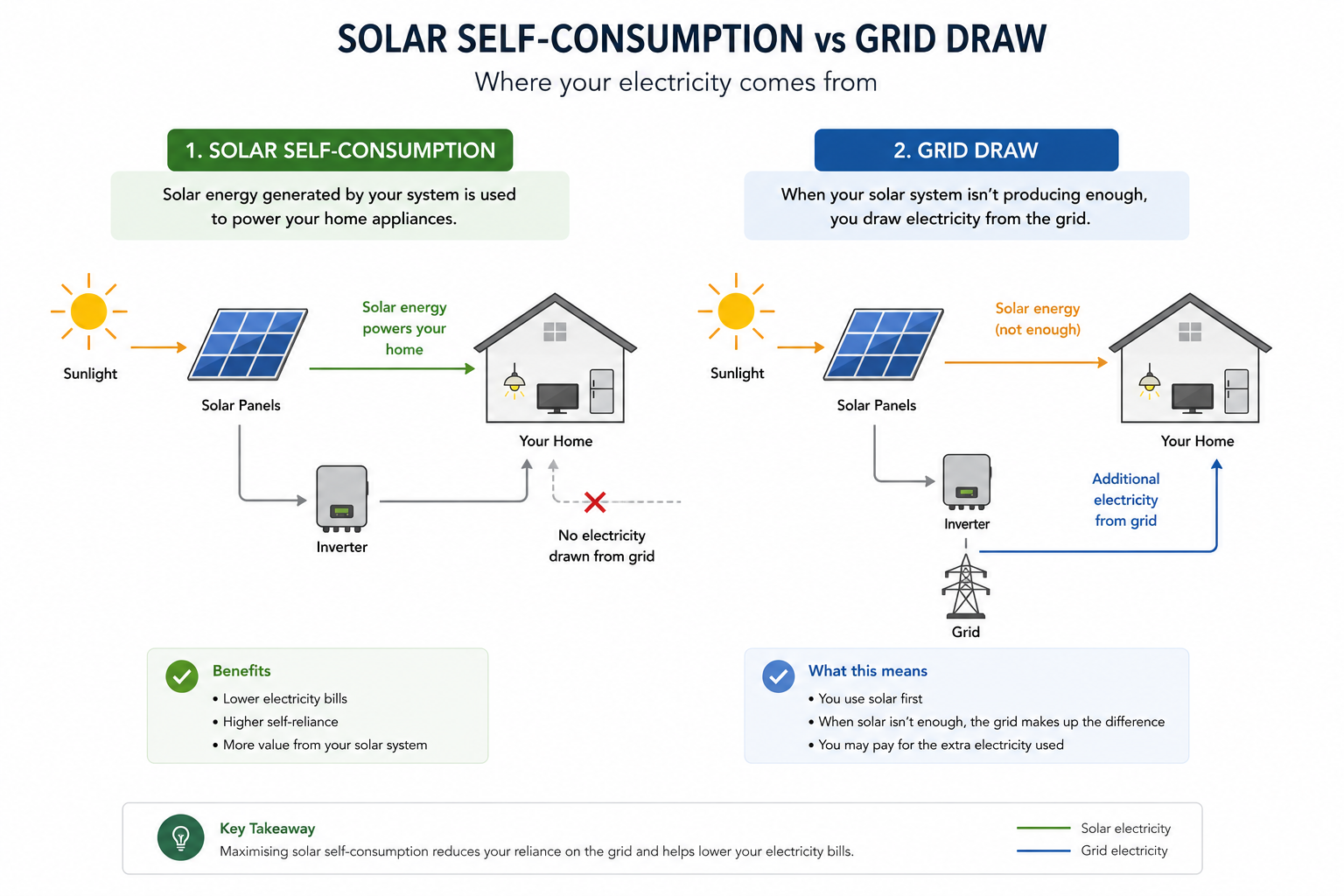
When your solar panels generate electricity during the day, your home uses that power directly instead of drawing it from the grid. The saving for each kilowatt-hour (kWh) of solar energy you consume equals the retail electricity rate you would otherwise pay. In Sydney, that's roughly 27–34c per kWh, depending on your plan.
Every kWh of solar you consume yourself is a kWh you don't buy. That's the core financial case for solar: it replaces expensive grid electricity with energy generated at near-zero marginal cost.
What about exporting to the grid? Excess solar that gets sent back to the grid earns a feed-in tariff (FiT). In 2026, feed-in tariffs typically sit at 3–5c/kWh, significantly less than the retail rate.
That means self-consuming your solar is worth three to five times more than exporting it. Getting solar panel orientation right, and sizing your system around your actual load profile, directly determines how much of your solar production you actually use.
Battery storage extends this self-consumption window into the evening, when grid rates are at their highest. If you're using 20 kWh/day and drawing heavily from the grid after 5pm, battery storage can shift that cost significantly.
A well-designed solar system can deliver substantially greater bill savings than a system that isn't properly matched to a household's energy consumption patterns. Guwing Green's SAA-accredited engineers model actual household load profiles rather than relying on generic averages before recommending a system.
That's what separates a correctly sized installation from one that just fills the available roof space.
For homeowners ready to understand exactly what's possible, our residential solar solutions page outlines what that process looks like. For business owners comparing grid costs against a solar investment, our guide to commercial solar payback provides a closer look at the numbers.
5 Ways to Lower Your Electricity Cost per kWh
1. Compare and Switch Plans
Use the government comparison tools such as Energy Made Easy (NSW, QLD, SA, ACT, TAS) or Victorian Energy Compare (VIC). They're free, unbiased, and don't earn commissions. If a retailer's plan is priced 10% below the reference price, it's generally a good deal; above it, you're likely overpaying.
2. Shift Loads to Off-Peak Windows
If you're on a TOU tariff, run appliances like dishwashers, washing machines, or/and EV chargers overnight or during off-peak windows. Off-peak rates in NSW can be 15–20c/kWh compared to 45c+ at peak. Not on TOU yet? It may be worth switching if you can adjust your routine.
3. Run an Energy Audit First
Before spending on solar or a battery, know where your energy actually goes. An energy audit identifies the high-consumption loads in your home, often the most cost-effective kWh is the one you stop wasting altogether. This step is frequently skipped, and it's frequently the most valuable one.
4. Install a Well-Designed Solar System
A system sized to your actual usage maximises self-consumption and shortens payback. Before committing to any quote, it's worth understanding how to evaluate what you're being offered. Our solar quote guide walks through exactly what to look for.
5. Add Battery Storage for Evening Coverage
Batteries shift unused daytime solar into the peak evening hours when grid rates are highest. With the federal Cheaper Home Batteries Program currently offering rebates on eligible installations, the economics have improved considerably in 2026. Battery storage savings are worth modelling seriously if you're an evening-heavy household.
Frequently Asked Questions
What is the average electricity price per kWh in Australia in 2026?
The average residential rate sits somewhere between 30 and 35 cents per kWh, depending on state, retailer, and tariff structure. South Australia is consistently the most expensive at around 40–45c/kWh. Victoria and Tasmania sit at the lower end. NSW (Sydney, Ausgrid network) typically falls in the 27–34c range on a competitive market offer. These are usage rates only — your bill also includes a daily supply charge of around $1.00–$1.50 regardless of consumption.
Why is my electricity bill high even if my rate seems reasonable?
Two main culprits. First, the daily supply charge adds up fast — a household paying $1.20/day racks up over $435 per year before consuming a single kWh. Second, high-consumption appliances (ducted air conditioning, pool pumps, EV charging) multiplied by a 30–34c rate accumulate quickly. An energy audit can identify exactly where the money is going.
Is it worth going solar to reduce my electricity cost?
In most cases, yes, particularly in NSW and SA where grid rates are higher. Each kWh of solar you self-consume saves you the full retail rate. For a Sydney household using 20 kWh/day, a well-sized system can reduce grid draw by 60–80% during daylight hours. The key is getting a system designed around your actual loads, not a cookie-cutter configuration.
What is a daily supply charge and why do I pay it?
It's a fixed daily fee for being connected to the electricity network, such as poles, wires, meters, and maintenance. You pay it whether you use power or not. It typically ranges from $1.00 to $1.50 per day depending on your state and distributor, adding $365–$550 per year to your annual bill.
How does a time-of-use tariff work?
A TOU tariff charges different rates depending on when you use power: peak (typically weekday afternoons and evenings), shoulder, and off-peak (overnight). If you can shift most of your usage to off-peak windows, you can pay significantly less per kWh than on a flat rate plan. You need a smart meter to access TOU tariffs.
Conclusion
Electricity prices in Australia vary considerably by state, distributor, and plan, but understanding the c/kWh figure on your bill is where taking control starts.
For most households, the combination of a competitive retail plan, smart tariff choice, and a well-designed solar system is the most reliable path to cutting what you pay per unit over the long term.
The starting point isn't always solar, sometimes it's understanding your consumption first. For an honest assessment of your roof, your bills, and your options, connect with Guwing Green's engineers.
Filed under