Facility managers and business owners frequently ask whether a factory, warehouse, or cold storage plant needs a standard commercial system or a true industrial-scale solar setup.
While both generate three-phase power from rooftop PV arrays, industrial solar operates under different load requirements, electrical infrastructure demands, and government certificate schemes.
Evaluating commercial solar for businesses requires understanding what separates a standard commercial setup from an industrial-grade system. Guwing Green designs and delivers both, from small commercial rooftops to full industrial-scale arrays, so the guidance below reflects real engineering trade-offs rather than a generic sales pitch.
What Are Industrial Solar Panels and How Do They Differ From Commercial Panels?
The term "industrial solar panels" rarely refers to a different physical solar module. Instead, it describes how high-capacity panels are configured to handle the heavy, continuous electrical demands of industrial sites.
Understanding the boundary between commercial and industrial solar comes down to site operational demands rather than building footprint alone.
Scale and Load Profile, Not Just a Bigger Roof
Industrial facilities run continuous heavy three-phase electrical loads from manufacturing equipment, heavy motors, refrigeration plants, or automated processing lines.
Unlike standard office buildings that peak briefly during daytime HVAC hours, industrial sites maintain constant, heavy energy draw throughout operating shifts. Systems at this scale start at roughly 100kW capacity and above, engineered from 12 months of granular 30-minute interval meter data rather than simple floor-area estimates.
Why the 100kW Mark Is the Line That Matters
For over a decade, the 100kW mark served as the strict regulatory dividing line in Australia's renewable energy target framework.
- Systems Under 100kW (STC Pathway): Generate Small-scale Technology Certificates (STCs). These certificates act as an immediate point-of-sale discount, lowering upfront system cost at the time of installation.
- Systems at or Above 100kW (LGC Pathway): Transition into the Large-scale Renewable Energy Target (LRET). Instead of an upfront point-of-sale discount, these systems create Large-scale Generation Certificates (LGCs) progressively over time based on actual megawatt-hours generated.
Certificate schemes directly affect payback timeframes, which matters most to facility managers weighing up project economics. Our commercial solar power guide breaks down the financial mechanics of STCs versus LGCs and local distribution network service provider (DNSP) approvals in full detail.
The Certificate Threshold Is About to Change
The regulatory line between commercial and industrial solar incentives is changing for the first time in over a decade.
What's Changing from October 2026
On 5 August 2026, the Clean Energy Regulator announced a government proposal to expand eligibility under the Small-scale Renewable Energy Scheme (SRES). Under the proposed policy, the system capacity threshold for upfront STCs increases from 100kW up to 1MW for eligible solar systems installed from 1 October 2026 (subject to final regulations being made).
What This Means for Procurement Timing
For NSW industrial businesses planning systems between 100kW and 1MW, this policy shift changes project economics:
- Upfront Cost Reduction: Expanding the SRES allows mid-scale industrial systems (such as a 250kW factory roof array or a 500kW warehouse setup) to claim an immediate upfront capital discount rather than claiming small annual LGC payments over time.
- Streamlined Financial Approval: Removing the administrative overhead of ongoing LGC creation, registration, and brokerage simplifies internal CFO procurement approvals.
- Strategic Procurement Planning: Facility managers currently designing mid-scale arrays can time site commissioning to align with the regulatory rollout, maximising capital efficiency without sacrificing system capacity. Guwing Green's engineering team tracks these regulatory dates closely and can help sequence design, grid application, and commissioning around the 1 October 2026 change.
Where Industrial Solar Gets Used Across NSW
Manufacturing and Processing Plants
Manufacturing facilities operate heavy motor loads, electric furnaces, pneumatics, and automated assembly lines that draw continuous power during operating hours.
Solar generation maps cleanly against these daytime manufacturing shifts, allowing plant managers to consume generated solar directly on site rather than buying expensive peak-tier grid power.
Cold Storage and Food Processing
Refrigeration compressors run constantly, with electrical demand peaking during hot summer months when ambient temperatures force cooling equipment to work hardest. Solar generation hits its peak during these exact same hot daylight hours. This natural alignment yields high self-consumption rates for cold storage facilities in Western Sydney and regional NSW logistics hubs.
Warehouses and Distribution Centres
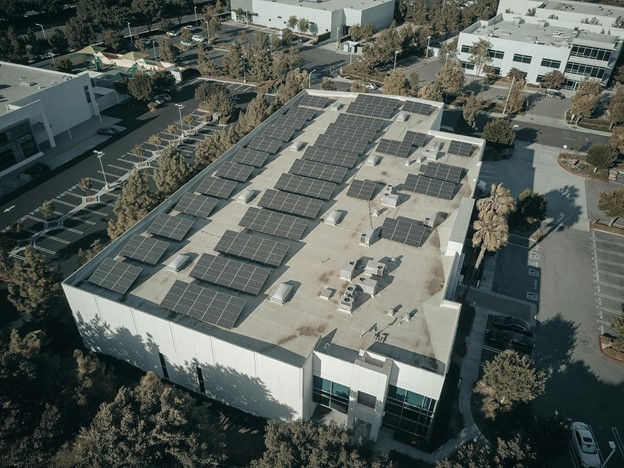
Logistics centres across major industrial corridors (such as Eastern Creek, Western Sydney Airport precincts, and the Central Coast) feature vast, flat roof areas receiving unshaded sunlight.
While a logistics building's internal power usage might be lower than a manufacturing plant's, these extensive roof spaces allow operators to install high-capacity arrays that eliminate daytime power bills and charge fleet vehicles or site forklifts.
Rooftop or Ground Mount for an Industrial Site?
Industrial operators must determine whether mounting hardware on the primary roof deck or installing a ground-mounted array delivers better long-term engineering performance.
Guwing Green's SAA-accredited engineers assess this trade-off on-site for every industrial project, rather than defaulting to whichever mounting method is easiest to install.
When Ground Mount Makes Sense on Industrial Land
When an industrial site includes unallocated land, ground-mounted arrays offer significant structural and maintenance advantages. Ground mounts eliminate roof penetration risks, allow optimal tilt orientation regardless of building position, and make cleaning and electrical maintenance straightforward.
If your facility features surrounding land or roof structural limitations, our guide to ground mounted solar panels details NSW planning rules, wind-loading engineering, and council approval pathways.
Roof Considerations on Large Industrial Buildings
Mounting hundreds of kilowatts of solar hardware on an industrial roof requires structural verification before installation begins.
- Roof Sheet Profiles: Industrial roofs in NSW typically feature Klip-Lok, corrugated Colorbond, or concrete decking. Klip-Lok roofs allow non-penetrating seam clamps that secure mounting rails without drilling holes through the metal skin, preserving building waterproofing warranties.
- Structural Dead Loads and Wind Loading: Large solar arrays add physical weight (dead load) and create aerodynamic lift during severe coastal storms (wind load). Guwing Green's SAA-accredited engineers verify that roof purlins, trusses, and structural steelwork can bear this load, working alongside a structural engineer's certification before any mounting hardware goes up.
Pairing Industrial Solar with Battery Storage
Multi-shift industrial facilities running evening or 24/7 schedules gain maximum independence by combining high-capacity solar arrays with commercial battery energy storage systems (BESS).
Guwing Green's battery design work is led by Brad Fawcett, who has personally overseen more than 40 MW of battery storage installed across Australia, so BESS sizing is engineered around your load profile rather than sold as a standard package.
Storing excess daytime solar generation allows a facility to discharge stored power during high-tariff evening windows (commonly 4:00 PM to 9:00 PM, though the exact hours depend on your network operator), reducing expensive peak demand charges.
What It Costs and How It Pays Back
Evaluating an industrial solar investment requires analysing how direct daytime self-consumption shortens payback windows.
Why This Guide Doesn't Repeat the Numbers
Financial returns for industrial-scale systems depend on site-specific interval meter data, structural roof profiles, and distribution network connection requirements.
Under the IPART 2026–27 benchmark determination, flat export rates sit at 3.4c to 6.5c/kWh. At an industrial scale, exporting large volumes of power back to the grid yields minimal return compared to directly replacing grid imports priced between 25c and 40c/kWh.
How Guwing Green Designs an Industrial-Scale System
High-capacity commercial solar requires specialised engineering, strict grid compliance, and site-specific load profiling.
Sized From Real Data, Not a Rule of Thumb
- 12 Months of Interval Data Analysis: We analyse your facility's 30-minute interval smart meter records to map exact power draw across every shift, ensuring system capacity aligns with real daytime consumption.
- Network Provider Approvals: Systems over 100kW require formal connection applications with local network distributors (such as Ausgrid, Endeavour Energy, or Essential Energy), including secondary protection engineering and export management controls.
To see how specialised engineering functions in practice, take a look at our real-world bespoke solar projects, including our 100kW commercial system installation in Russell Lea, NSW.
Frequently Asked Questions
Is my factory or warehouse "industrial" or "commercial" for solar purposes?
Categorisation depends on your facility's electrical load profile, connection type, and target system capacity rather than its council zoning. If your site operates heavy three-phase machinery, runs continuous processing shifts, or requires a system capacity of 100kW or greater, it falls into the industrial solar category.
Do industrial-scale solar panels need council approval in NSW?
Rooftop solar installations on commercial and industrial buildings generally qualify as Exempt Development under NSW planning provisions, provided they meet height, setback, and structural safety standards. Ground-mounted systems or installations on heritage-listed buildings require formal council development applications (DA) or Complying Development Certificates (CDC).
Can an existing commercial system be expanded to industrial scale later?
Yes, provided your main switchboard, transformer capacity, and roof space permit expansion. Expanding an existing array requires evaluating network export limits, updating inverter protection gear, and reviewing current certificate eligibility rules with an SAA-accredited engineer, ideally one of Guwing Green's, before adding extra panels.
Does the NSW Home Energy Saver Program cover industrial-scale solar?
No. Home Energy Saver is a NSW Government program for eligible households, not commercial or industrial sites, so it sits outside the certificate pathways covered in this guide. Guwing Green is registered as an accredited vendor under the program, delivered through Plenti, meaning eligible homeowners and landlords can pair a zero-interest loan of up to $15,000 with the federal STC rebate on residential-scale upgrades. If your business's decision-maker is also weighing up a home solar or battery upgrade, this is worth asking our team about separately.
The right industrial solar system is the one sized to your facility's actual daytime electricity demand, not a generic capacity guess. With the federal certificate threshold about to jump to 1MW, timing your procurement now can capture the maximum upfront rebate.
Contact our engineering team to request a commercial solar proposal built specifically for your site's operational requirements.
Filed under