Solar panels are made of simple things you see every day: glass, aluminium, copper and silicon, all held together with protective sealing layers. None of these materials are exotic or uncommon.
Understanding what is actually inside a panel helps you spot quality gear for yourself, rather than relying on sales spin.
Below we explain what solar panels are made from, what each material does, whether any of it is hazardous, and what happens to your system at the end of its life, with a look at what all of this means for solar on everyday Sydney homes.
The Main Materials Inside a Solar Panel (By Weight)
If you took a standard panel apart and weighed the pieces, the breakdown might surprise you. Silicon does all the actual work, but it makes up only a tiny fraction of the overall weight.
| Material | Share by weight | What it does |
|---|---|---|
| Glass | 77% | Protects the front of the panel from weather |
| Aluminium | 10% | Forms the sturdy outer frame |
| Polymers (encapsulant and backsheet) | 9% | Seal the cells and protect the back layer |
| Silicon | 3% | The active ingredient that generates power |
| Copper, silver and tin | Under 1% combined | Internal wiring that carries the electricity |
| Lead | Under 0.1% | Trace amounts in the internal solder |
This recipe applies to crystalline silicon panels, which make up over 95% of the 4.4 million rooftop systems currently spinning electricity meters across Australia.
Breaking Down the Layers
Silicon: the part that generates electricity
Silicon acts as the semiconductor that does the heavy lifting. When sunlight hits a silicon cell it knocks electrons loose and gets them moving, and that movement creates an electrical current, known as the photovoltaic effect.
Manufacturers use silicon because it is abundant, non-toxic, highly efficient at converting sunlight, and durable enough to back the 25 to 30 year warranties now standard across the industry.
Glass: the protective front layer
The front face is a sheet of tempered, low-iron glass, typically 3.2mm thick. Some premium double-glass panels use sheets as thin as 2.0mm to save weight, while heavy-duty weather panels go up to 4mm.
This glass is built to withstand heavy hail and flying debris while staying completely clear, so the maximum amount of sunlight passes straight through to the cells underneath.
The aluminium frame
The frame provides structural support and gives installers a mounting point to secure the panel to your roof. It is also the most commonly recycled panel component in Australia, since aluminium recovery is well established and economically viable.
Copper wiring, encapsulant, backsheet and junction box
- Copper busbars and wiring carry the current generated by the cells out of the panel and into your system.
- EVA (ethylene vinyl acetate) encapsulant seals the cells in place and blocks moisture and UV degradation.
- The polymer backsheet insulates and protects the rear of the panel.
- The junction box houses and protects the electrical connections where the panel wiring exits.
Does the Panel Type Change the Materials?
All three panel types are still primarily silicon, glass and metal. What differs is how that silicon is processed, and that affects efficiency, cost and appearance.
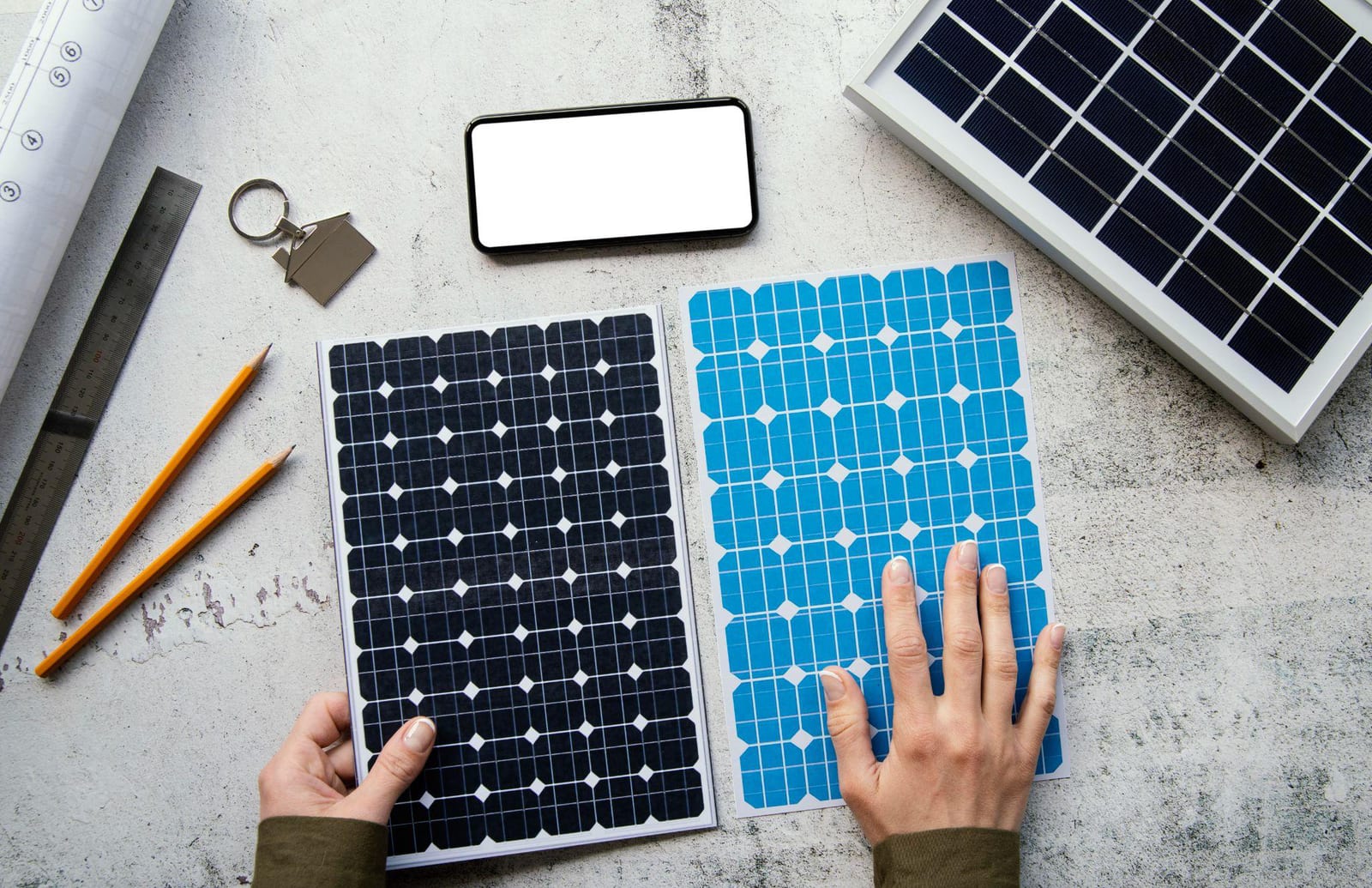
- Monocrystalline cells are sliced from a single, pure crystal of silicon. They have a sleek, uniform black look and offer the highest efficiency on the market.
- Polycrystalline cells fuse multiple silicon crystals together, giving the recognisable blue hue. They were cheaper and less efficient, and manufacturers have now stopped making them entirely.
- Thin-film panels use cadmium telluride or amorphous silicon and are lighter than crystalline panels, but with lower efficiency. They are mostly used in utility-scale solar farms rather than on Sydney homes.
Efficiency figures move every year as manufacturing improves, so check current ranges against a live spec sheet rather than an old one. Our full comparison of monocrystalline versus polycrystalline panels covers the numbers in detail.
Are Solar Panels Made of Toxic Materials?
No. Standard crystalline silicon panels are not hazardous in normal use.
The International Energy Agency has confirmed that the only real point of concern in commercially produced panels is the trace amount of lead used in internal solder, and manufacturers are increasingly moving toward lead-free alternatives.
Thin-film cadmium telluride panels do contain cadmium, but it is sealed within the panel structure, and that technology is uncommon on Australian residential rooftops where crystalline silicon dominates.
Why Panel Materials Matter for Your Home
Sydney's environment puts serious pressure on outdoor equipment over a 25 to 30 year lifespan. Anywhere near the coast, from the Northern Beaches to Cronulla, salt air corrodes cheap, low-grade aluminium frames and roof fixings.
Intense summer UV also discolours and degrades cheap backing sheets and plastic sealants, which leads to moisture ingress and early panel failure. This is exactly where the difference between a bargain panel and a premium one shows up, and it usually shows up years after the sale.
When comparing quotes, look past the price tag and check the manufacturer's track record. A Tier 1 rating is a useful signal, but it only measures a manufacturer's financial bankability, not the quality of its materials or workmanship, so treat it as one data point rather than proof of a premium panel. Knowing how to read a solar quote matters just as much before you sign anything.
What Happens to These Materials at End of Life?
It is worth being precise here, because recyclable and recycled are not the same thing. Panels are made of roughly 95% recyclable materials, including aluminium, glass, silicon, silver and copper.
In practice, government figures put Australia's actual recycling rate at around 17% by weight. Most old panels still end up in landfill, but that is shifting quickly.
NSW is leading here with two dedicated, EPA-backed solar recycling facilities: PV Industries at Bankstown, which can process up to 200,000 panels a year right here in Sydney, and Sircel at Parkes, capable of around 160,000 panels annually.
On top of that, a federal National Solar Panel Recycling Pilot backed by $24.7 million launched in mid-2026. It will establish around 100 collection sites nationwide to test how decommissioned panels can be collected and recycled, feeding into a future product stewardship scheme.
If you are installing a brand-new system today, this is not an immediate worry. Quality modern panels last 25 to 30 years and still produce around 85% of their original output at the 30-year mark. The recycling infrastructure is catching up well before your panels reach retirement age.
FAQ About Solar Panel Materials
Are solar panels made of toxic materials?
No. Standard crystalline silicon panels are safe in normal use, with only trace, sealed amounts of lead or, in the rare case of thin-film panels, cadmium.
What's the difference between monocrystalline and polycrystalline panels?
Monocrystalline panels are cut from a single silicon crystal, generally offering higher efficiency and a uniform black look. Polycrystalline panels fuse multiple crystals together, giving a blue hue and lower efficiency. Polycrystalline is no longer manufactured.
Can solar panels be recycled in Australia?
Yes, technically. Around 95% of a panel's materials are recyclable, but only around 17% is currently recycled onshore. Sydney readers have practical options through the NSW facilities at Bankstown and Parkes.
How long do the materials in a solar panel actually last?
Panels typically have a 25 to 30 year design life, with the quality of the glass, frame and encapsulant all affecting how well a system holds up over that time.
Conclusion
Solar panel materials are simple, reliable and safe. The real difference between a bargain-basement panel and a premium system is how well those basic materials are sourced, framed and sealed against harsh Australian weather.
Once you know what is inside a panel, the next question is which one is right for your roof. If you are ready to see what a properly built system looks like for your property, book a consultation, and our engineers will assess material and build quality when recommending a system for you.
If you are also weighing up storage, our guide on whether a solar battery is worth it covers that decision separately.
Filed under