

How efficient are commercial solar panels today? Most panels sold in Australia sit at 20% to 22% efficiency, with premium models reaching 23% to 24%, according to SolarQuotes.
Commercial roofs use the same panel technologies, just in larger formats. At the very top end, back-contact panels have now reached 25%.
TaiyangNews' September 2026 ranking lists back-contact modules from AIKO and LONGi at 25%, followed by JA Solar's TOPCon module at 24.1% and Risen Energy's HJT module at 23.8%.
A higher percentage does not automatically translate into better financial returns, since roof space, system size and site conditions all affect the result just as much as the panel itself.
Getting that assessment right is a core part of designing commercial solar for your business properly.
Below, we’ll cover what efficiency actually measures, where the current range sits for a commercial install, and when it genuinely changes the result for a roof. We also explain how Guwing Green's engineers factor it into a design, so you know what to ask for when you review a quote.
What Does "Solar Panel Efficiency" Actually Mean?
Solar panel efficiency is easy enough to quote, but the percentage needs context before you can compare panels properly. So what does the figure actually measure?
How Efficiency Is Measured
Every panel's efficiency rating comes from testing under Standard Test Conditions: a 25°C cell temperature and fixed irradiance of 1,000 W/m², the same baseline used across the industry globally.
The resulting figure is expressed as the percentage of sunlight hitting the panel that actually converts to usable electricity.
Under those conditions, a 22%-efficient panel converts 22% of the sunlight reaching its surface into electricity. The other 78% is lost to reflection, heat and conversion losses within the cell itself.
Efficiency vs Power Output vs System Size
A higher-wattage panel is not automatically a more efficient one. Wattage depends on physical size as much as cell technology, so a larger, lower-efficiency panel can still output more raw power than a smaller, higher-efficiency panel sitting next to it.
This is where a lot of confusion comes from. A "550W panel" and a "22%-efficient panel" are answering two different questions. One measures total output, the other measures output per square metre.
Mixing the two up is how a business ends up comparing panels on the wrong metric. It might pick a high-wattage panel for a roof where efficiency per square metre was the real constraint, or the reverse.
How Efficient Are Commercial Solar Panels Right Now?
The table below shows where each panel technology sits today.
Typical Efficiency by Panel Technology
| Technology | Current Commercial Module Efficiency |
|---|---|
| Monocrystalline PERC | Around 20% to 22% |
| N-type TOPCon | Around 22% to 24% |
| Heterojunction (HJT) | Up to about 23.8% |
| Back-contact | Up to 25% |
That 25% is for a panel you can actually buy today, not a laboratory result. The ranges in the table line up with SolarQuotes' panel efficiency data.
The national picture points the same way. The Australian Renewable Energy Agency's July 2026 white paper update puts laboratory silicon cells at 27.9% and commercially available modules at 26.2%, up from around 22% in 2022, as PV Tech reports.
That top-end figure sits a little above the 25% in TaiyangNews' listing, so treat 25% as the practical ceiling when you compare quotes.
A bifacial panel carries the same front-face rating as an equivalent monofacial model, then adds a separate rear-side gain on top of it. That gain is not captured in the efficiency percentage at all, and we cover it in more detail below. Our guide to monocrystalline vs polycrystalline panels explains how the main cell types compare in practice.
What Businesses Are Actually Installing Today
Most commercial panels on offer fall in that same 20% to 24% range, and TOPCon panels are now widely used for new commercial projects. Polycrystalline panels are largely absent from new commercial work because manufacturers have moved toward newer cell technologies.
Clean Energy Regulator data for the June quarter of 2026 puts the national average small-scale system size at 10.5 kW, the fourth quarter in a row above 10 kW. Systems between 15 kW and 40 kW made up 26% of installations, up from 16% a year earlier.
These figures cover every small-scale system up to 100 kW, homes included, so read them as a direction of travel rather than a commercial snapshot.
Replacement systems made up around 25% of small-scale installations in the June quarter, the second quarter in a row at that level. That matters if your business already has older panels on the roof. Newer modules can fit more capacity into the same space, and an energy audit shows whether an upgrade is worth it.
Does a Higher Efficiency Rating Actually Mean a Better System?
The answer depends almost entirely on how much roof is actually available, and the effect is bigger than a single percentage point suggests.
When Efficiency Is the Deciding Factor
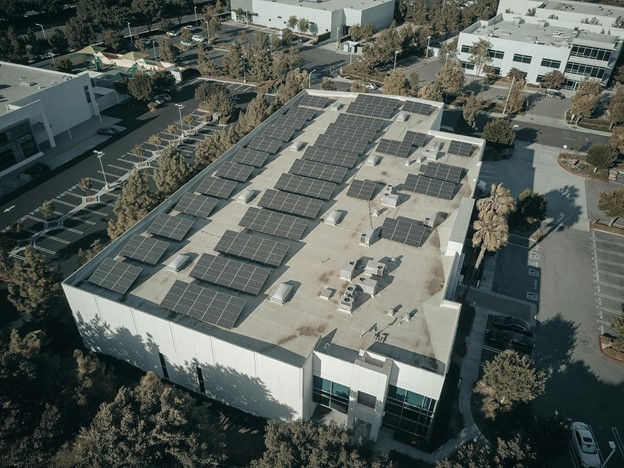
Roof space, not price, decides whether efficiency matters.
A small CBD office roof, a heritage-listed building or any site with a fixed footprint may have little room for panels. Higher-efficiency modules fit more rated capacity into the available area.
For heritage roofs, conservation areas and multi-orientation roofs, Guwing Green's engineers take on bespoke projects designed around the site.
Here is what that looks like on a real roof. Two panels of identical physical size, one at 23% efficiency and one at 24.8%, may look close on paper.
Across an array of 150 modules, however, that gap adds roughly 7 kW of extra rated capacity from the same physical area (assuming modules of about 2.6 m² each).
For a tight commercial site, that can be the difference between covering your facility's baseline load and falling short. It also brings two practical benefits:
- Covering More of Your Load. Where space limits how many modules fit, higher efficiency closes the gap between what the roof can physically hold and what your equipment needs.
- Claiming More Upfront Support. Small-scale Technology Certificates (STCs) are based on a system's rated capacity, along with its location and installation date. Fitting more kW onto the same footprint can mean a bigger upfront discount, within the scheme's size limits, without needing any extra roof space.
The following site conditions are worth checking before treating efficiency as the deciding factor:
- Roof-Constrained Layouts. Look for extensive HVAC plant equipment, skylights, complex multi-angle pitches, parapets, fire setbacks, or local heritage zoning that caps the clear space available.
- High Daytime Consumption Profiles. Businesses whose daytime energy use outstrips the space available for standard modules.
When It Barely Changes the Outcome
A large, unobstructed warehouse or industrial roof removes the constraint entirely. With enough usable space to fit the required capacity regardless of panel efficiency, the rating becomes one input among several, not the deciding one.
When space isn't the limit, these factors deserve more of your attention:
- Product and Performance Warranties. Look for panels with a low annual degradation rate and a performance warranty that covers 25 to 30 years of output.
- Temperature Coefficients. On hot days, heat losses matter as much as the STC figure. A panel with a low temperature coefficient holds more of its output when cell temperatures pass 65°C, so it can outperform a higher-efficiency panel with a poor thermal rating.
- Installation Quality and the Rest of the System. Mounting, switchboard integration and inverter design usually affect uptime more than a small difference in panel efficiency.
This is the situation industrial-scale solar is built around. On an open roof, the constraint that efficiency solves isn't there, so the decision shifts to total system economics.
Working out which situation you're in is what an energy audit is for. At Guwing Green, our engineers turn twelve months of your interval meter data into a payback model, so the panel choice follows your load and your roof rather than a datasheet percentage.
Factors That Affect Commercial Solar Panel Efficiency
The efficiency rating on a datasheet comes from standard test conditions, not a typical Sydney afternoon.
Real-world performance changes as the panels heat up, receive sunlight from different angles or operate with shading and other roof constraints.
Heat and the Temperature Coefficient
Solar panels lose a little output as they heat up.
The power temperature coefficient shows how much output falls for each degree above the 25°C cell temperature used for the Standard Test Conditions (STC) rating. A typical range for crystalline silicon modules is around 0.2% to 0.4% per °C.
That figure needs some context for Sydney. A 40°C day does not mean the panel cells are at 40°C. Under strong sunlight, the module temperature can rise above the surrounding air temperature.
At 40°C cell temperature, a coefficient of 0.2% to 0.4% translates to roughly 3% to 6% less output than the STC rating. Higher cell temperatures produce a larger reduction. At 65°C, which is possible in full summer sun, the same range means a loss of roughly 8% to 16%.
Sydney Airport records an average of about 5.5 days per year at or above 35°C and about 0.9 days at or above 40°C in the Bureau of Meteorology's current climate statistics. Further west, Sydney Olympic Park averages about 10.5 days a year at or above 35°C.
Temperature coefficients also vary between technologies.
For example, REC's heterojunction (HJT) modules are rated at -0.24% per °C, while LONGi's back-contact modules are rated at around -0.26% per °C. A lower coefficient means a panel holds on to more of its output on hot days, which can narrow the gap with a panel that has a higher efficiency rating.
Orientation, Tilt, and Shading
Panel efficiency is only one part of how much electricity reaches the meter. The direction and angle of the array affect how much sunlight reaches the panels throughout the day, while shading from nearby buildings, trees or rooftop equipment reduces generation.
NSW Government guidance describes north-facing roofs as the most suitable for solar and south-facing roofs as usually unsuitable. East and west-facing roofs can still perform well in a sunny location like Sydney, as the City of Sydney notes.
An east/west array may produce slightly less annual energy than an optimally oriented north-facing array, but the generation profile can line up better with a business that uses more electricity in the morning or afternoon.
For a commercial site, that timing matters alongside total annual generation.
Shading deserves particular attention because even a small obstruction can cut the output of the modules it falls on. Roof-mounted plant, vents, parapets and neighbouring buildings should all form part of the site assessment. Guwing Green's design engineers check all of this before they recommend a panel or an inverter.
Bifacial Gain on Flat Commercial Roofs
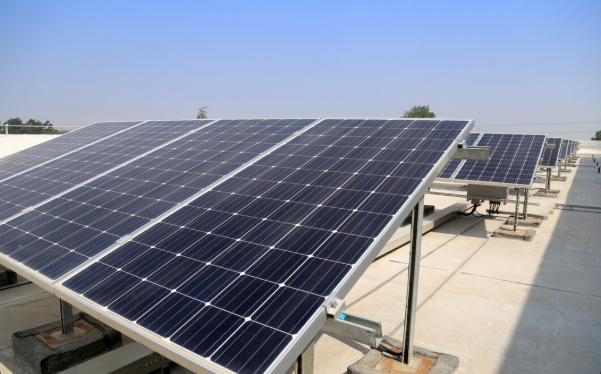
Bifacial modules add another consideration because their rear side also receives light. The standard efficiency rating still describes the module's front-side performance, while reflected and diffused light reaching the rear can add to actual energy generation.
Flat commercial roofs with light-coloured membrane surfaces provide a useful setting for bifacial modules because those surfaces reflect more light toward the rear of the panel. The actual gain varies with roof surface, panel height, row spacing, mounting arrangement and local conditions.
For realistic gain ranges and the roof types where bifacial technology makes the most sense, see our guide to bifacial solar panels.
Does Efficiency Change Your STC Rebate or System Sizing?
A higher efficiency rating may mean fewer panels are needed to reach a given system size. It does not, by itself, increase the STCs available for that system.
Efficiency Doesn't Change Your Rebate Per Kilowatt
The number of STCs a system can create is based on factors such as the system's capacity, location and installation date, not the panel's efficiency percentage. For a given system capacity, a higher-efficiency panel means fewer panels are needed to reach the same kW rating.
For example, a 100 kW system built with higher-output panels may use fewer modules than a 100 kW system using lower-output panels. The system capacity is still 100 kW, so the efficiency percentage itself does not create an additional STC entitlement.
For the full rebate and certificate breakdown, plus commercial system sizing, see our commercial solar power guide.
Scaling Past 100 kW
The Small-scale Renewable Energy Scheme (SRES) rules have changed for larger solar systems. Eligible solar PV systems installed from 1 October 2026 can now fall within the expanded SRES range from 100 kW up to 1 MW, subject to the scheme's eligibility requirements. Before this change, systems above 100 kW could only earn large-scale generation certificates (LGCs).
The Clean Energy Regulator says the regulations have now been amended, but STC applications for mid-scale systems won't open until mid to late November 2026.
Systems in this range also get a fixed five-year deeming period, and owners choose between STCs and Renewable Electricity Guarantee of Origin (REGO) certificates for the same system, not both.
If you sized a project to stay under the old 100 kW limit, it's worth revisiting. A larger system may now qualify for STCs, but capacity, installation timing and eligibility all need checking before you commit. The CER's own analysis suggests systems of this size take at least eight months from design to approval, so it pays to start early.
Guwing Green's engineering team tracks the SRES rollout and assesses system sizing, site requirements and procurement timing as part of the project planning process.
How Guwing Green Designs a Commercial System Around Your Roof
Efficiency is one input. The right system comes from your meter data, your roof and your budget. Here's how that works with Guwing Green.
- Start with a consultation. We look at your site, your energy use and your goals first. It suits businesses that are ready to buy, still weighing up whether solar fits, or holding a quote from another company.
- Design from your own data. Our SAA-accredited design engineers work from your actual meter data, operating hours and site requirements, then prepare a preliminary design and proposal. An energy audit goes further, turning twelve months of interval meter data into a payback model.
- Choose panels to suit the roof. We're technology neutral. A tight CBD roof might justify premium high-efficiency panels, while an open warehouse roof often does better with a standard TOPCon panel at a lower cost.
- Handle the grid connection and install. Our project team submits the grid connection application to your electricity distributor. Once it's approved, our SAA-accredited installers fit the system, with installation typically scheduled within two to four weeks.
- Put the figures in writing. Designs, payback figures and install windows are written down before any contract is signed.
Guwing Green was founded by Paul Trad, who holds a Master's in Photovoltaic Systems from UNSW and has delivered more than 30 MW of solar. That engineering background is why the process starts with your data rather than a sales pitch.
If you're also looking at solar or a battery for your home, Guwing Green is an accredited vendor for Home Energy Saver loans through Plenti. We explain how that works in the FAQs below.
To see what this looks like for your own roof, book a consultation with our team.
FAQs
What efficiency percentage is considered good for a commercial system in 2026?
For a new commercial system in 2026, 22% to 24% is a solid benchmark. Modern n-type TOPCon and heterojunction (HJT) panels typically land in that range. The right figure still depends on your roof space, system size and site conditions. Guwing Green's engineers weigh those alongside your energy use to decide whether higher-efficiency panels give you a practical advantage.
Do more efficient panels cost more?
Sometimes. Some premium panels, such as certain back-contact and HJT models, carry a higher price per watt, but efficiency and price don't always move together. A higher-efficiency panel from one brand can cost less than a lower-efficiency panel from another, so compare the price per watt on the actual quote. The real question is whether your roof space justifies any premium. On an open roof, paying extra for the highest datasheet percentage rarely makes financial sense compared with a system sized properly to your load.
Does a higher efficiency rating mean a shorter payback?
Not necessarily. On a large, open roof, a higher efficiency rating mostly shrinks the footprint without adding generation. If the panels cost more per watt, that can lengthen your payback, because you're paying extra for output you would have had anyway. Fewer panels can trim racking and labour costs, which can offset part of the premium. An energy audit shows which situation you're in before you spend extra on panels.
How much does Sydney's summer heat reduce commercial panel output?
On a hot, sunny day, cell temperatures can pass 65°C. With a typical temperature coefficient of 0.2% to 0.4% per °C, that means output falls by roughly 8% to 16% against the STC rating at that moment. That's a peak-afternoon loss, not an annual average, since Sydney Airport sees only about 5.5 days a year at or above 35°C. A lower temperature coefficient helps, and Guwing Green's engineers compare it alongside your roof angle and load profile when they choose between panel technologies.
Is Guwing Green an approved provider for NSW schemes like Home Energy Saver?
For households, yes. Guwing Green is listed as an accredited vendor in Plenti's Home Energy Saver vendor directory. That means eligible NSW homeowners and landlords can use the program's zero-interest loan of up to $15,000, repayable over up to 10 years, towards an approved rooftop solar or battery system installed by us. Home Energy Saver is a household program, though, so it doesn't cover a commercial system. According to the NSW Government, loans are for NSW homes owned by owner-occupiers or landlords with a combined taxable household income of up to $210,000. A separate discount of up to $4,000 for lower-income households and concession card holders is listed as coming soon. For a business, the main support is the STC discount under the Small-scale Renewable Energy Scheme, which now reaches systems up to 1 MW. Guwing Green is also a NETCC Approved Seller, and our design engineers and installers are SAA-accredited, which STC claims depend on. We'll confirm which schemes apply to your site during your consultation.
Can Guwing Green review an efficiency claim in a quote I already have?
Yes. Even if the quote came from another company, our engineers can check the panel choice, system size and payback figures against your roof and meter data. The first step is a quick consultation, and you can book one here.
Conclusion
Knowing how efficient commercial solar panels are gives you a useful benchmark when comparing quotes.
The bigger question is how much usable generation capacity the roof can support and whether the proposed system matches the business's electricity demand.
Guwing Green's SAA-accredited engineers assess roof space, site conditions and energy requirements before recommending a panel, and we'll tell you plainly whether higher efficiency is worth paying for on your roof.
Talk to our team to review your commercial solar requirements and discuss the available options.
Filed under