
A solar feed-in tariff is the credit your electricity retailer pays you for each kilowatt-hour of unused solar your system sends back to the grid.
For the 2026-27 financial year, the IPART benchmark range has dropped again. Understanding how your distribution network, export charges and the time of day you export all shape that credit is what puts you back in control of the bill.
What Is a Feed-in Tariff, and Is It a Rebate?
A feed-in tariff is an ongoing payment arrangement between you and your retailer. When your panels generate more than the house consumes in real time, that surplus flows out through your smart meter into the grid, and your retailer credits it in cents per kilowatt-hour against your quarterly bill.
It is completely separate from government subsidies or upfront installation discounts. If you are comparing the two, our guide to NSW solar rebates and incentives covers the upfront side.
Unlike some states that historically set legal price floors, NSW runs a fully deregulated retail market. The NSW Government does not mandate a minimum feed-in tariff. Retailers choose whether to offer one at all, and they have complete discretion over the rate, the terms and any daily export caps written into your contract.
The NSW Benchmark for 2026-27
Because there is no statutory minimum, IPART publishes an annual benchmark to give households a fair reference point when reviewing retail offers. It reflects the projected wholesale market value of solar exported during daylight hours.
For 2026-27, running 1 July 2026 to 30 June 2027, the benchmark range for flat all-day feed-in tariffs is 3.4 to 6.5 cents per kilowatt-hour. That is a notable step down from the 2025-26 benchmark of 4.8 to 7.3 cents.
| Financial year | IPART all-day benchmark |
|---|---|
| 2024-25 | 4.9 to 6.3 c/kWh |
| 2025-26 | 4.8 to 7.3 c/kWh |
| 2026-27 | 3.4 to 6.5 c/kWh |
Retailers are under no obligation to match that range. Some offer higher promotional rates to attract sign-ups, while others drop below 3 cents or cap the higher rate at a strict daily threshold such as 10 kWh a day.
The driver behind the trend is the sheer volume of solar now connected across the National Electricity Market. On clear days, hundreds of thousands of NSW rooftop systems hit maximum output simultaneously. That injection of zero-marginal-cost generation floods the grid between 10:00 AM and 3:00 PM, wholesale prices during those hours drop close to zero and occasionally turn negative, and export credits shrink to match.
Evening Exports Are Worth Far More
While daytime wholesale prices have collapsed, grid demand stays intensely high in the late afternoon and early evening. IPART publishes time-of-use benchmarks that assign significantly higher values to electricity exported during those peak windows, calculated separately for each of the three NSW distribution networks.
| Network | Coverage | Time-of-use export benchmark |
|---|---|---|
| Ausgrid | Sydney Basin, Central Coast, Hunter | 17.2 to 18.7 c/kWh for exports between 4:00 PM and 9:00 PM |
| Endeavour Energy | Western Sydney, Blue Mountains, Illawarra, South Coast | 16.9 to 19.9 c/kWh for exports between 4:00 PM and 8:00 PM |
| Essential Energy | Regional and rural NSW | 26.6 to 33.3 c/kWh for exports between 5:00 PM and 8:00 PM |
Regional owners on the Essential Energy network sit in an unusual position. Longer transmission distances and regional grid constraints make late-afternoon power on their network exceptionally valuable under the benchmark framework.
There is a catch, though. Most standard residential plans still pay a flat daytime export credit across the entire day. To earn those higher evening rates you need a retailer offering a dedicated time-of-use feed-in tariff plan, and a system paired with battery storage capable of dispatching power during those specific hours.
What the Export Charge (Sun Tax) Means by Network
Australian Energy Regulator determinations allow NSW distribution networks to implement two-way pricing. Often called an export charge or sun tax, it introduces a financial signal for pushing power into an already congested local grid.
These tariffs are set by the network operators, not by IPART or your retailer, and the three distributors manage congestion differently.
| Network | Export charge structure | Export reward |
|---|---|---|
| Ausgrid | Around 1.2c/kWh on exports above a free monthly threshold of roughly 200kWh between 10:00 AM and 3:00 PM | Explicit export rewards, currently 3.85c/kWh, for solar dispatched during late afternoon and evening peaks |
| Endeavour Energy | Export charge above baseline daily allowances during peak daylight generation hours | Credits for exports delivered during evening peak demand hours |
| Essential Energy | Network export pricing adjusted for long-distance regional distribution constraints | The state's highest theoretical evening export credits, to encourage local generation |
The intent behind two-way pricing is not to punish solar owners. Localised voltage rises caused by concentrated midday exports force distributors to spend capital upgrading substations and lines. Charging a small fee for excessive midday export while crediting evening dispatch pushes owners to store surplus locally or shift household use into the middle of the day.
If your home absorbs its own generation or stores the surplus in a battery, you never cross the export threshold. Self-consumed energy avoids export charges entirely.
How to Check and Compare Your Own Feed-in Tariff
Feed-in tariffs change quickly, so checking your current rate means looking at your own documentation rather than a static online table.
- Check your latest bill or Basic Plan Information Sheet.
- Note your current feed-in tariff in cents per kWh, and any daily export caps.
- Check your usage rate in cents per kWh and your daily supply charge.
- Enter your National Meter Identifier into Energy Made Easy to compare live offers.
Your latest bill lists the feed-in rate alongside the total exported units credited for the cycle. The Basic Plan Information Sheet, which every retailer publishes for every plan, spells out feed-in rates, daily export limits and tiered rates. To compare offers objectively, use the Australian Government's free service at Energy Made Easy, rather than commercial comparison sites that only show paid partners or publish best feed-in tariff tables that go stale within weeks.
Be cautious with high headline export rates. Promotional tariffs of 12c or 16c per kWh usually carry conditions:
- Fixed contract durations. Rates locked to a 12 or 24-month contract, dropping back to a low default once the promotional window ends.
- Daily export limits. A retailer might pay 15c/kWh on your first 5 or 10 kWh of daily exports, then drop to 3c/kWh for everything beyond that.
- Inflated retail tariffs. High feed-in rates are often offset by higher usage charges or elevated daily supply charges. Paying an extra 8 cents per kWh for grid power overnight wipes out the gain from an extra 3 cents on daytime exports.
A lower feed-in tariff attached to competitive supply and usage rates often produces a smaller total bill than a high headline rate attached to expensive usage charges. Our breakdown of electricity prices per kilowatt-hour in Australia shows how far those usage rates vary.
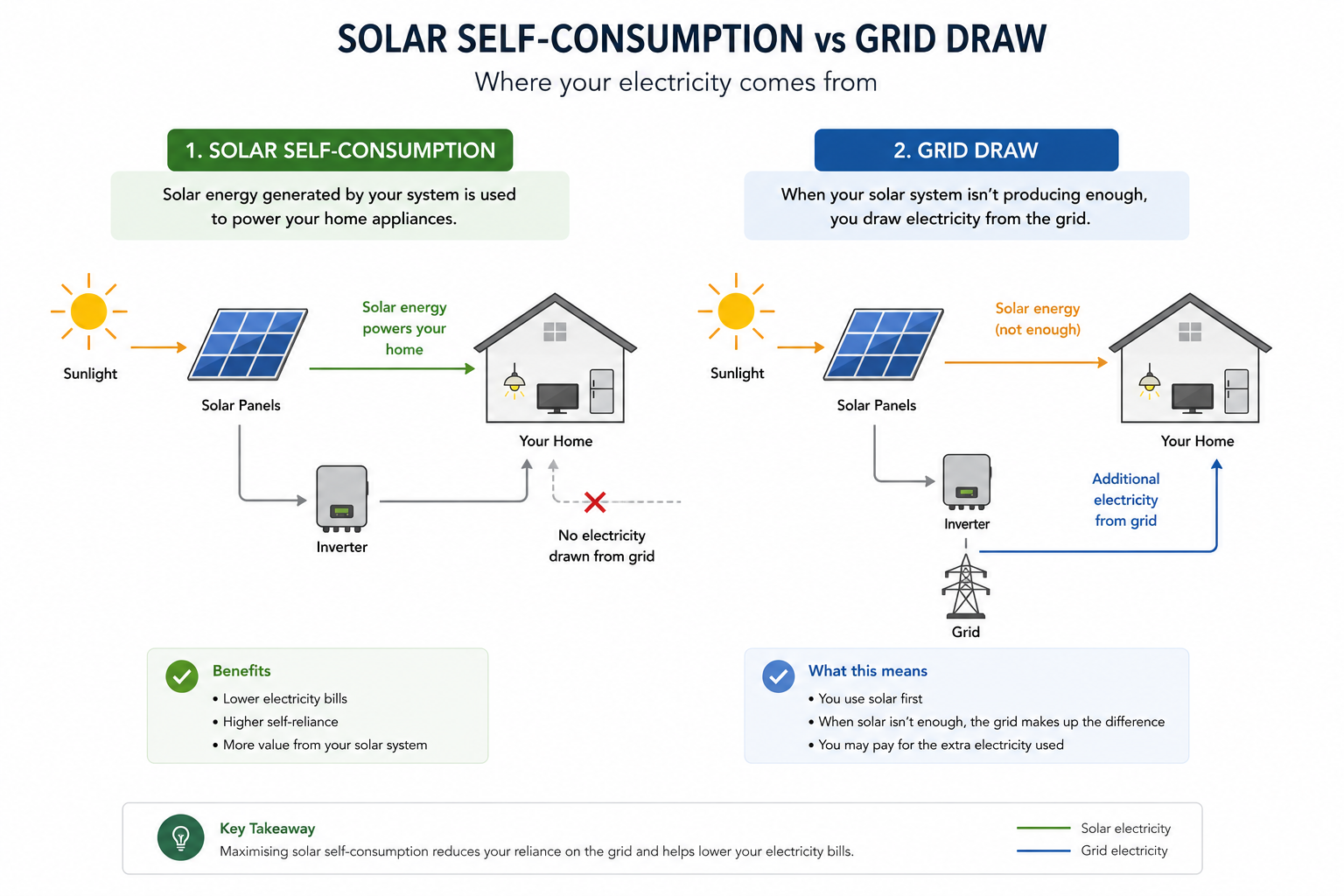
Why Self-Consumption Matters More Than the Export Rate
The maths governing residential solar in NSW has shifted permanently. When feed-in tariffs sat at 15 to 20 cents per kWh, designing a system to maximise raw export volume made financial sense. At 3.4 to 6.5 cents, chasing export volume yields diminishing returns.
Export a kilowatt-hour and your retailer credits you between 3.4 and 6.5 cents. Buy that same kilowatt-hour back that evening and you pay somewhere between 30 and 45 cents, or more during peak pricing windows. Every unit of solar you absorb internally replaces an expensive grid purchase, delivering roughly five to eight times more value than sending it into the street.
Adding a battery captures midday generation that would otherwise be exported for small change and stores it for peak evening use. Weigh that against a realistic solar battery payback period and the foundational question of whether a home battery is worth it in 2026.
Two market developments push further in the same direction:
- The Solar Sharer Offer. Since 1 July 2026, eligible NSW smart-meter households can opt into an AER-regulated offer giving up to three hours of free grid electricity, capped at 24kWh a day, during the 11:00 AM to 2:00 PM window. Pairing that window with smart appliance scheduling lets you run hot water, pool pumps and EV charging during the day and save stored battery capacity for the evening peak.
- Incentive stacking. Battery investments can be combined with the NSW Home Energy Saver Program, which offers zero-interest loans of up to $15,000 towards eligible upgrades. Guwing Green is approved to offer access through both of the program's finance providers, so the financing can be applied directly through your quote.
Get a System Sized to Your Own Export and Usage
A standard online quote usually starts and ends with a 6.6kW array sized to the roof: maximise the midday export, earn 3.4c/kWh for it, then buy evening power back at around 35c/kWh. In an environment with low export rates and active network export charges, an oversized array without storage control creates surplus exports that return very little.
An accurate design begins with your smart meter interval data, the granular record of consumption in 15 or 30-minute blocks. That reveals your base load, your daytime solar absorption and your peak evening import. It is exactly what an engineering energy audit is built to produce.
Sized this way, a system captures and stores the energy you actually need, minimises exposure to network export charges, and stops depending on a shrinking feed-in tariff to make the numbers work.
Frequently Asked Questions
Is there a minimum feed-in tariff in NSW?
No. NSW operates a fully deregulated retail electricity market with no government-mandated minimum. IPART sets a voluntary annual benchmark range, 3.4 to 6.5 cents per kWh for 2026-27, but retailers remain free to set their own rates, impose daily export limits, or offer no feed-in tariff at all.
Why did my feed-in tariff drop?
Retailers adjust export credits to reflect the IPART benchmark and declining wholesale values. Because so much rooftop solar floods the grid in the middle of the day, wholesale prices during sunny windows have fallen sharply, and export credits track that underlying value.
Do all NSW retailers offer the same feed-in tariff?
No. Rates vary by retailer and by plan, and differ depending on whether the plan uses a flat daytime rate or a time-of-use structure, as well as which distribution network connects your property. Always compare total plan costs, including daily supply and usage charges.
Does a battery let me earn the higher evening rates?
It can, but two things have to line up. Your retailer needs to offer a time-of-use feed-in tariff plan, and your battery has to be configured to dispatch during the specified evening window. Neither happens automatically.
Is Guwing Green an approved provider for the NSW Home Energy Saver Program?
Yes. Guwing Green holds NETCC Approved Seller accreditation and SAA accreditation, the two credentials the program requires of an installer, and we are approved to offer access to the Home Energy Saver loan through Brighte and Plenti. Talk to our engineers to check eligibility and see how the loan fits into your quote.
Your Export Rate Is One Line on the Bill
A feed-in tariff on its own will not tell you whether your system is working for you. What matters is how much of your own generation you use, what you pay for the rest, and whether the system was sized around either of those things in the first place.
Guwing Green's SAA-accredited engineers size every solar and battery system against your household's real usage and export data, so you know exactly where the savings come from. Talk to an engineer to review your household's energy data.
Filed under